Knowledge-informed graph attention networks enable defect-free alloy design for laser additive manufacturing
A machine-learning framework that unites a physical-metallurgy knowledge graph with Bayesian uncertainty quantification — designing two new crack-free 3D-printable alloys from small experimental datasets.
Jiabo Fu†1,6, Hao Yu†1,6, Chenchong Wang✉1, Lingyu Wang1, Zhongji Sun✉2, Jinguo Li3, Sybrand van der Zwaag4, Dierk Raabe5, Wei Xu✉1
1 State Key Laboratory of Digital Steel, Northeastern University, Shenyang, China
2 Institute of Materials Research and Engineering (IMRE), A*STAR, Singapore
3 Institute of Metal Research, Chinese Academy of Sciences, Shenyang, China
4 Novel Aerospace Materials Group, TU Delft, the Netherlands
5 Max Planck Institute for Sustainable Materials, Düsseldorf, Germany
† These authors contributed equally · ✉ Corresponding: wangchenchong@ral.neu.edu.cn, zhongji-sun@outlook.com, xuwei@ral.neu.edu.cn
One framework, two new printable alloys
The study introduces UQ-KGAT — an Uncertainty-Quantified, Knowledge-informed Graph Attention Network — coupled with NSGA-II for inverse design of composition and process, and proves it by printing two entirely new alloys without cracks.
The problem
Alloys built by laser 3D printing crack and form pores; designing printable alloys needs huge, costly datasets that conventional ML depends on.
The idea
Encode physical-metallurgy knowledge as a graph, let a graph attention network learn from it, and quantify both statistical and model uncertainty.
The proof
Two brand-new crack-free alloys — KG-AMS Ni superalloy (1.3 GPa strength) and KG-AMAA Al alloy — designed, printed and validated.
Abstract
View at Nature.comMachine learning offers a promising approach to design high-performance alloys for laser additive manufacturing, by bypassing convoluted physical models and identifying correlations among composition, processing, microcracks/porosity and properties. However, conventional machine learning methods face limitations, e.g., overfitting or unreasonable design results, due to reliance on large, high-quality datasets. Here, we introduce a generic framework operable with smaller experimental datasets, by integrating knowledge-informed graph modeling alongside data uncertainty quantification. The generic physical-metallurgy knowledge and the stochasticity of experimental defect distributions from produced material are rationally balanced. To validate the approach, we detail the development of a new defect-free Ni superalloy possessing excellent laser printability, thermal stability, and high mechanical strength. Mechanism mining revealed a possible origin for this performance, which was confirmed by atom probe tomography. Subsequently, we developed a new laser-printable aluminum alloy through the same approach, highlighting the framework's potential to accelerate next-generation alloy design for additive manufacturing.
Why designing printable alloys is so hard
Laser additive manufacturing promises complex geometries and tailored microstructures — yet powders developed for casting or forging crack, oxidize and fail when laser-printed. Four compounding difficulties stand in the way.
Cracks & porosity are stochastic
Defects in AM parts show heterogeneous, random spatial distributions. Deterministic ML models built on 2D optical microscopy struggle to capture bulk defect levels reliably — a fundamental mismatch between model and reality.
Domain knowledge resists encoding
Materials behavior is governed by nonlinear, partially empirical principles. Qualitative guidelines and semi-quantitative models don't fit conventional numerical ML pipelines — so most studies optimize process parameters only.
Small, noisy datasets cause overfitting
Experimental alloy datasets are small and imperfect. Purely data-driven models overfit, extrapolate poorly, and generate unreliable inverse-design results — sometimes proposing alloys that cannot be printed at all.
Printability vs performance trade-off
High-strength Ni superalloys crack during printing; printable ones sacrifice strength. Breaking this trade-off requires co-optimizing composition AND process — a vast search space spanning 12+ elements and wide laser parameters.
The requirements: a framework that (1) assembles heterogeneous data — numerical, qualitative, empirical — to mitigate data scarcity and embed domain knowledge, and (2) reconciles statistical uncertainty (defect stochasticity) with model uncertainty (mean-field approximations) to stay reliable under real-world AM process variability.
UQ-KGAT: physics as a graph, uncertainty as a first-class output
Two stages: (i) build a physical-metallurgy knowledge graph and train an uncertainty-quantified graph attention network; (ii) hand the model to NSGA-II for inverse, dual-objective design of composition and laser process.
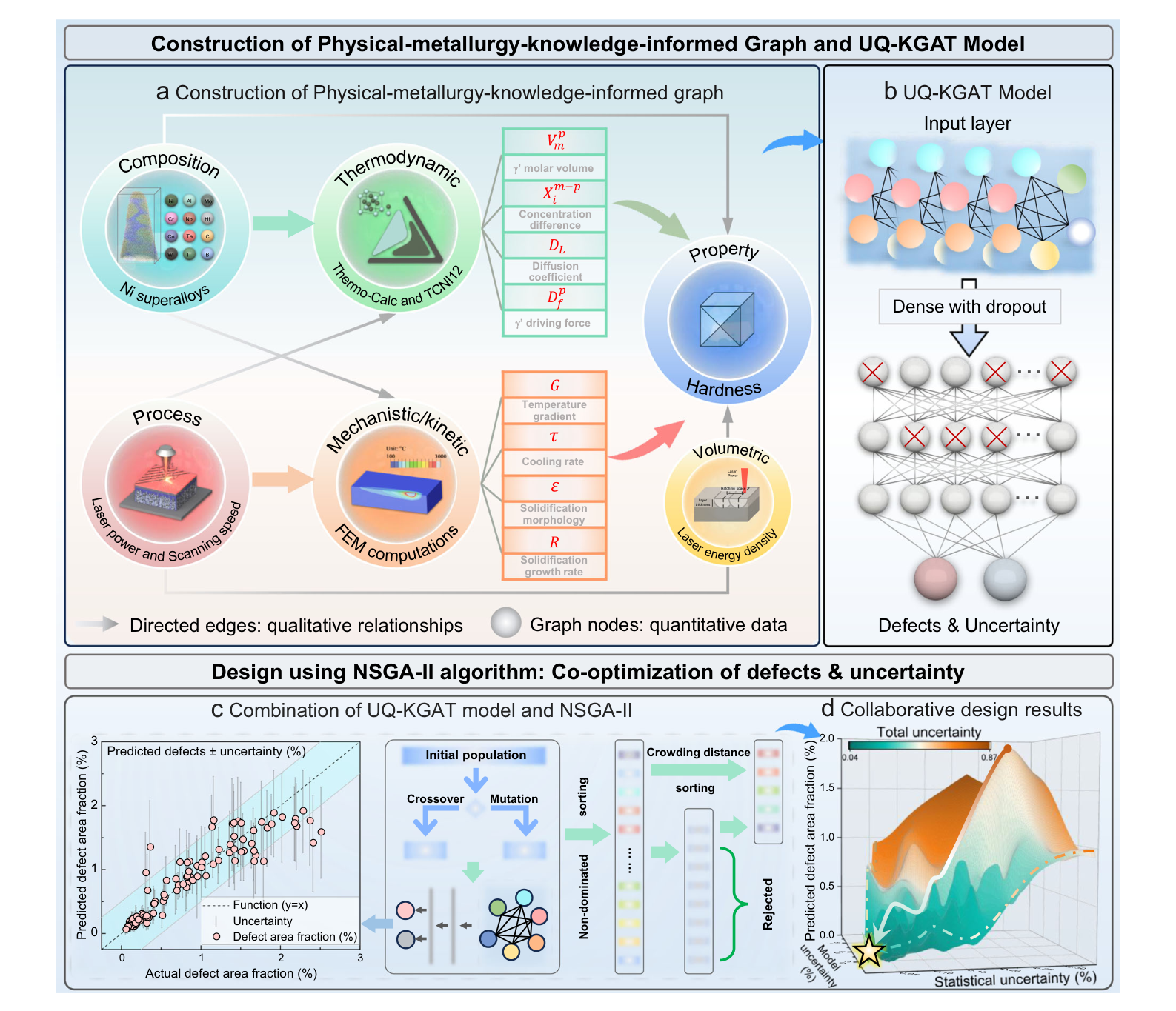
Knowledge-informed graph
Nodes hold quantitative data — composition, process, thermodynamic and solidification variables, hardness. Directed edges encode qualitative physical-metallurgy relationships, e.g. composition → γ′ driving force, so the model learns physics-aware attention instead of blind correlations.
Graph attention network
A GAT convolves features over the graph with learnable attention weights (LeakyReLU scoring + SoftMax normalization + multi-head averaging), prioritizing physically meaningful feature interactions even with limited training samples.
Heteroscedastic regression
Statistical (aleatoric) uncertainty is learned from data as a loss-attenuation factor — the model automatically predicts higher variance for noisy samples, down-weighting their influence during training.
Monte Carlo dropout
Model (epistemic) uncertainty is estimated by keeping dropout active at inference and measuring prediction variance across stochastic forward passes — a Bayesian view of what the model doesn't know.
NSGA-II inverse design
The UQ-KGAT serves as objective function inside a dual-objective genetic algorithm that co-optimizes defect level AND uncertainty over composition-process space — 13 decision variables, population 50, 1,500 generations.
Secondary-feature surrogates
Thermodynamic variables (Thermo-Calc TCNI12/MOBNI6), FEM solidification kinetics and hardness are predicted by fast surrogate models inside the design loop, slashing computational cost of each generation.
Explore the data behind the discovery
Every chart below is rendered live from the paper's official Source Data file — hover points, toggle models and compare model families yourself.
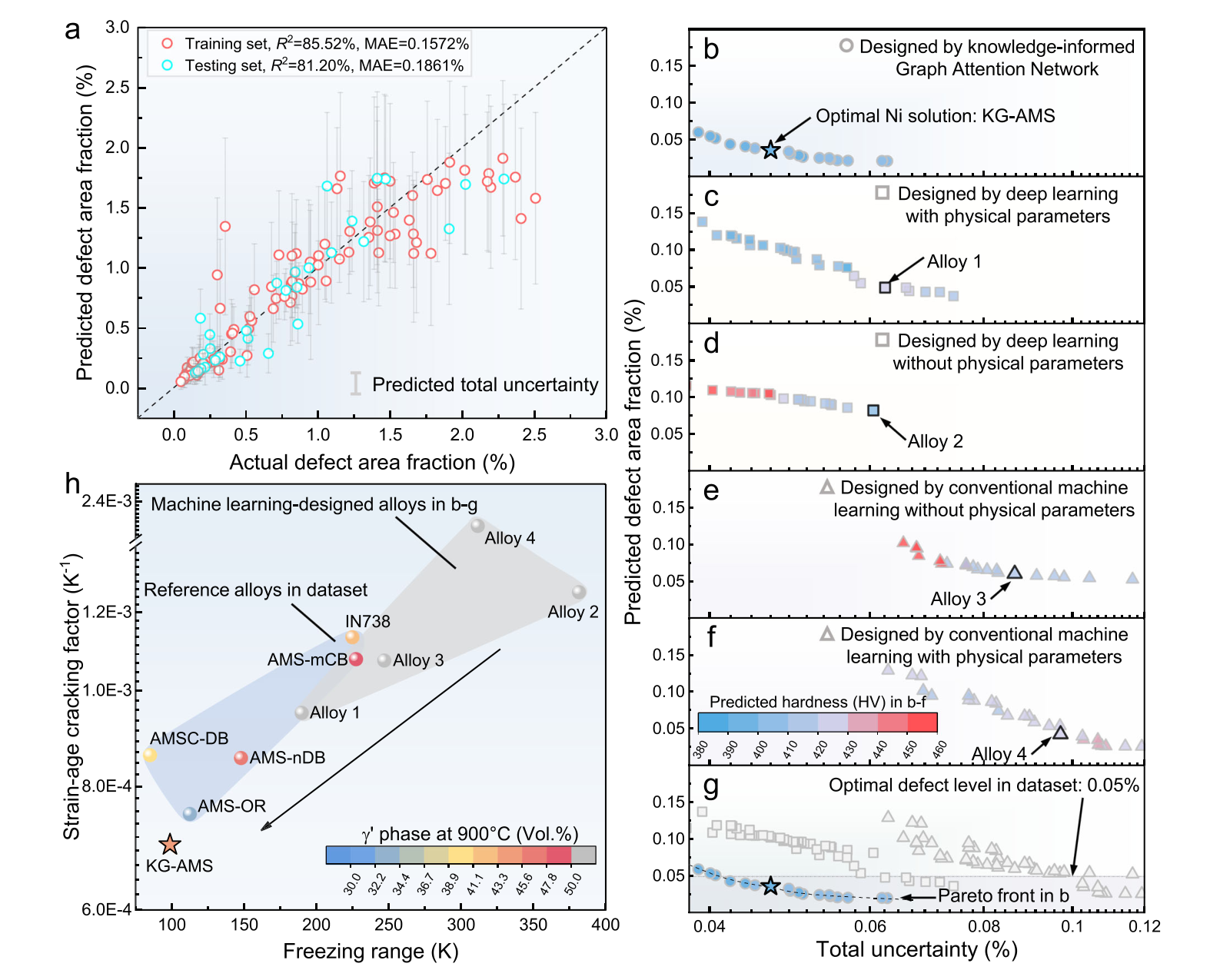
Defect prediction across the Ni-superalloy dataset
142 L-DED samples · 20 random 4:1 train/test splits · error bars show predicted total uncertainty (statistical + model)
Inverse design benchmark — Pareto fronts by model family
Toggle models to compare. Lower-left = better: low defects AND low uncertainty. Colors follow the paper's Fig. 2b–g; the dashed line marks the best defect level found in the dataset (0.05%).
Thermodynamic crack-susceptibility map
Freezing-range factor vs strain-age-cracking (SAC) factor, colored by γ′ content at 900 °C (log y-axis). Star = KG-AMS.
Two alloys that did not exist before this study
Designed by UQ-KGAT + NSGA-II, gas-atomized into powder, laser-printed and fully validated — compositions, properties and processing windows below come straight from the paper's Tables 1–2 and experimental campaigns.
★KG-AMS
Ni-based superalloyL-DED · 1,500 W / 10 mm s⁻¹ optimumKnowledge Graph-based Additive Manufacturable SuperalloyAlloy composition — KG-AMS
Table 1| wt.% | Al | Co | Cr | Mo | Ta | Ti | W | C | B | Nb | Hf | Ni |
|---|---|---|---|---|---|---|---|---|---|---|---|---|
| Designed | 6.31 | 14.59 | 5.06 | 0.25 | 1.56 | 0.14 | 2.25 | 0.21 | 0.01 | 2.1 | 0.006 | Bal. |
| Actual (ICP-OES) | 6.33 | 14.24 | 5.12 | 0.31 | 1.54 | 0.08 | 2.38 | 0.2 | 0.01 | 2.14 | 0.011 | Bal. |
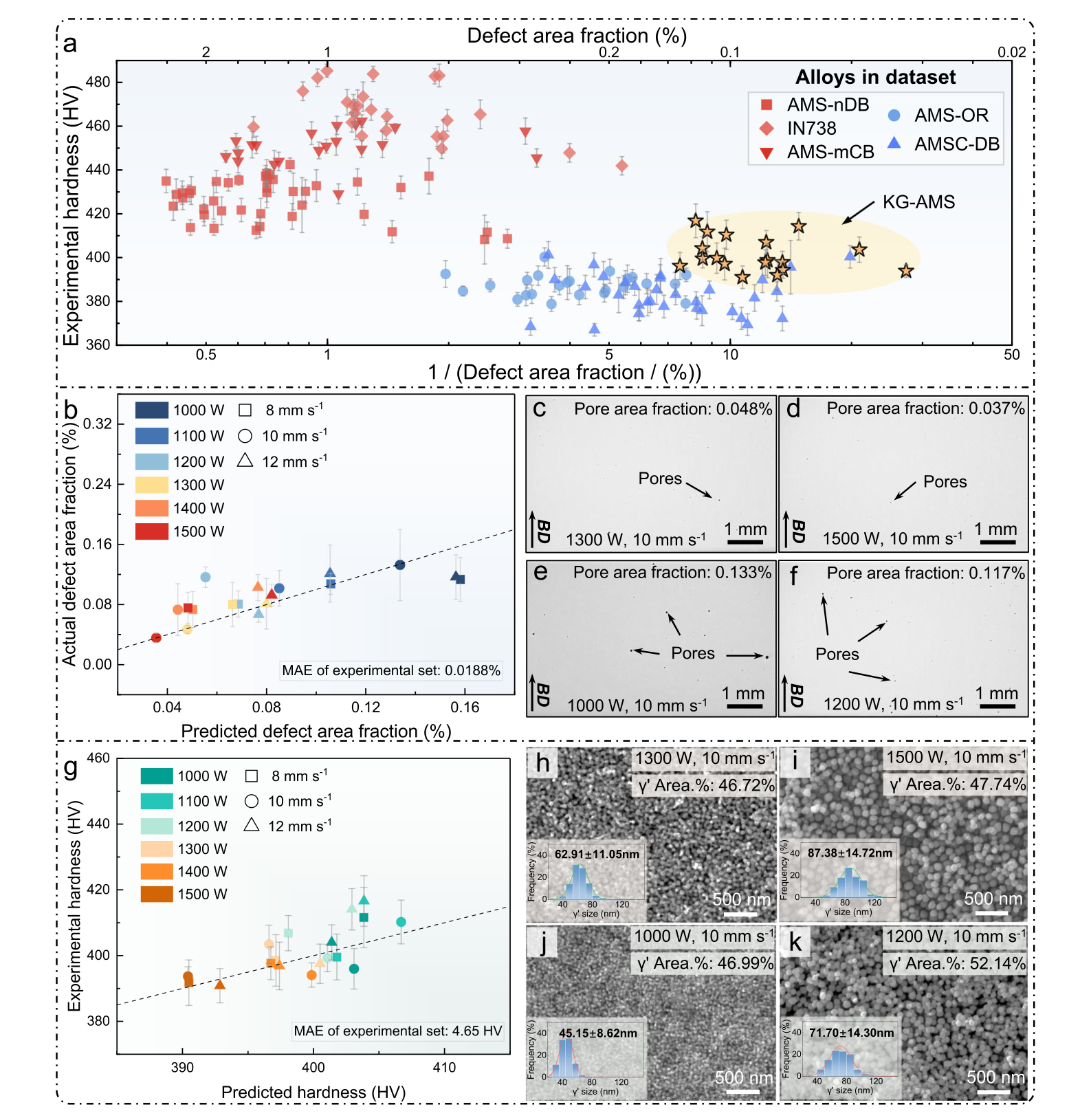
Why it works: mechanism mining (Integrated Gradients) flagged elements promoting γ′ formation (Nb) plus the thermodynamic variables — γ′ driving force and γ′ molar volume — as dominant factors. KG-AMS has a higher γ′ content (47.7%) than printable references (40.7%) while its compositionally stabilized γ/γ′ architecture keeps precipitation slow and uniform: minimal lattice misfit (0.05–0.07% vs 0.12% for the cracked reference) resists thermal-gradient destabilization during cyclic laser heating. Impurities: 100 ppm O, 20 ppm N, <10 ppm S. Powder D10/D50/D90 = 45.9 / 78.1 / 134.7 µm.
★KG-AMAA
High-strength aluminum alloyL-PBF · 350 W / 1,100 mm s⁻¹ optimumKnowledge Graph-based Additive Manufacturable Al AlloyAlloy composition — KG-AMAA
Table 2| wt.% | Si | Fe | Cu | Mg | Sc | Zr | Mn | Zn | Ni | Al |
|---|---|---|---|---|---|---|---|---|---|---|
| Designed | 4.41 | 0.2 | 2.63 | 0.11 | 1.08 | 0.001 | 0.47 | 0.4 | 0.25 | Bal. |
| Actual (ICP-OES) | 4.62 | 0.21 | 2.59 | 0.17 | 0.99 | 0.01 | 0.52 | 0.54 | 0.25 | Bal. |
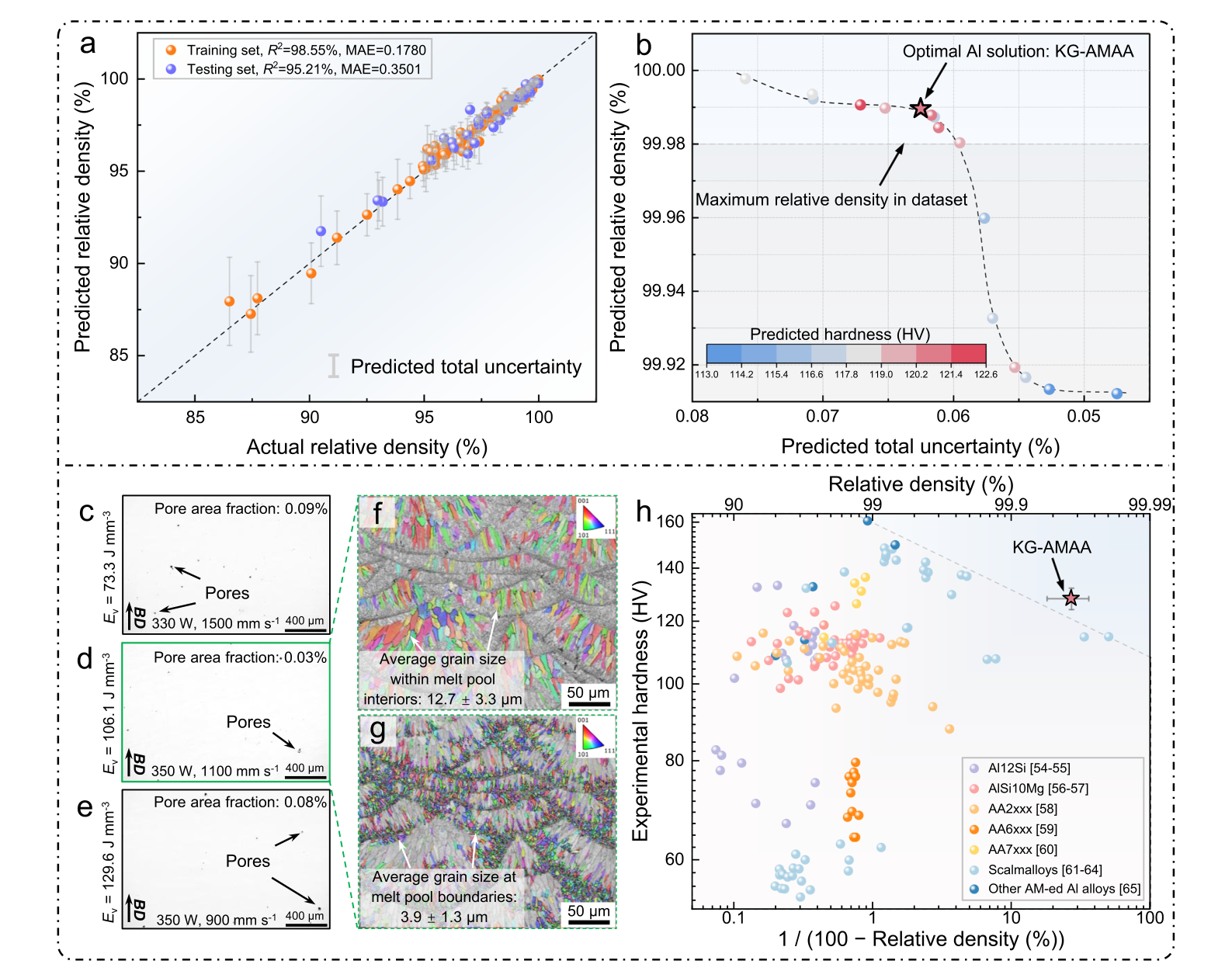
Why it works: thermodynamic analysis revealed favorable non-equilibrium solidification — primary Al₃Sc phases form during initial solidification and act as potent heterogeneous nucleation sites, refining the α-Al matrix to suppress epitaxial grain growth, residual stress and cracking. A narrow critical solidification interval (38.4 K) keeps hot-cracking susceptibility low, while ~10 vol.% of precipitates at lower temperatures provide strong precipitation strengthening. Powder D10/D50/D90 = 16.9 / 35.0 / 55.4 µm.
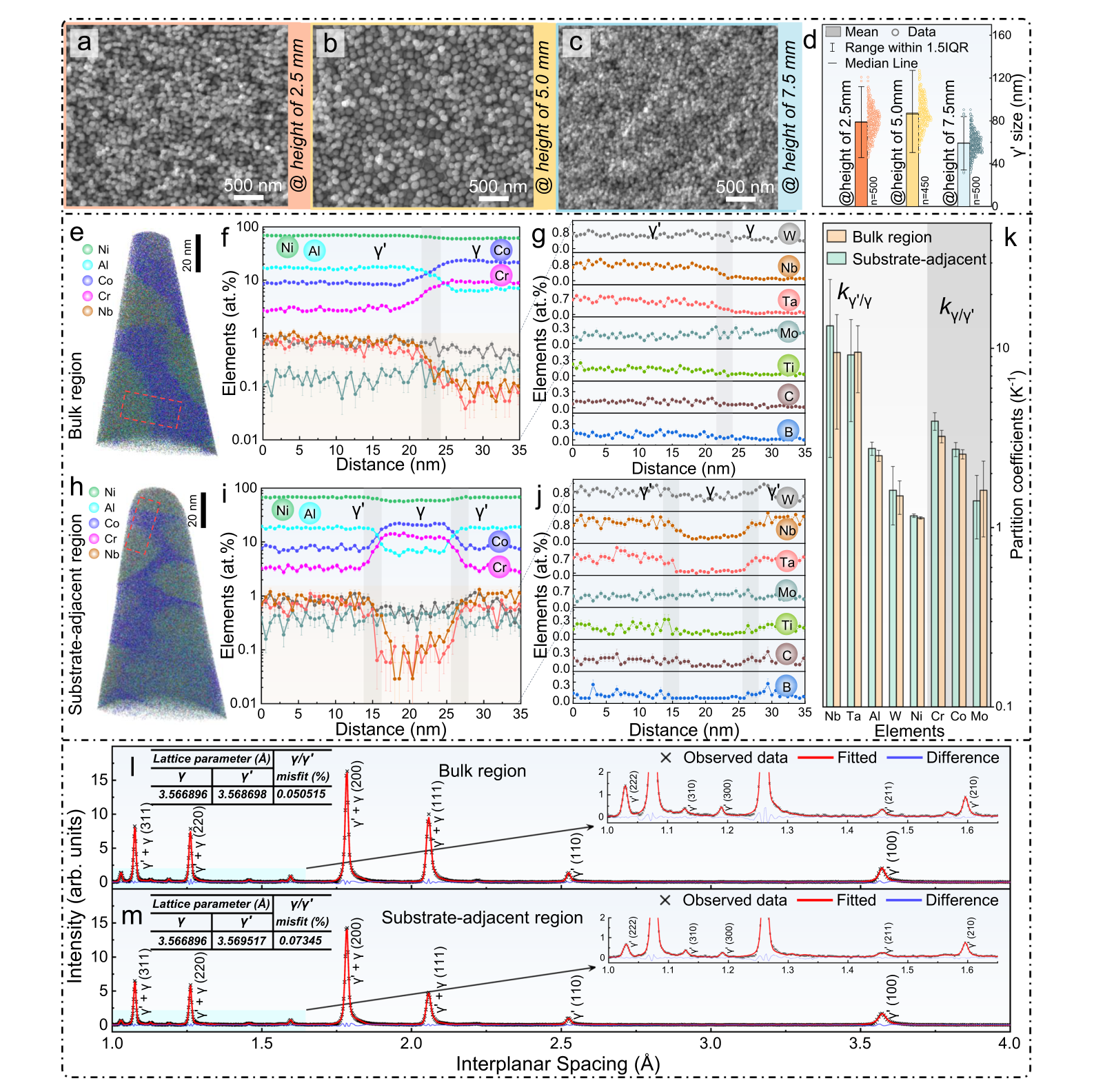
Data-driven mechanism mining, experimentally confirmed
Integrated-Gradients sensitivity analysis on the UQ-KGAT model predicted that γ′ thermodynamics dominate KG-AMS's exceptional behavior. APT, neutron diffraction and mechanical testing then confirmed it.
Atom probe tomography
CAMECA LEAP 6000XR, UV pulsing at 200 kHz / 25 pJ, ~50 K. Nb and Ta partition to γ′ with coefficients ≈ 10; Cr and Co to the matrix — identical in bulk (7.5 mm) and substrate-adjacent (2.5 mm) regions despite cyclic vs rapid cooling thermal paths.
Neutron diffraction
ERNI time-of-flight diffractometer at the China Spallation Neutron Source. Rietveld fitting gives γ/γ′ lattice misfit of 0.050% (bulk) and 0.073% (substrate-adjacent) in KG-AMS — versus up to 0.12% with tensile residual stress in the cracked reference alloy AMS-mCB.
Tensile & creep
1,307 MPa UTS with 22.2% elongation at RT; 655 MPa / 7.5% at 900 °C. Creep rupture: 97.8 h at 900 °C/200 MPa and 70.7 h at 800 °C/400 MPa — outperforming existing printable Ni superalloys including AMSC-DB.
Thermal stability
Uniform γ′ (87.4 ± 14.7 nm) insensitive to laser power across the whole window — the crack-prone reference shows 44.8–129 nm heterogeneity. Slow precipitation and coarsening kinetics minimize misfit despite repeated precipitation/dissolution events.
The element-level agreement between model mechanism mining and atom-scale APT measurement is the key epistemic win: the knowledge graph did not just fit the data — it pointed to the physical origin (controlled γ′ precipitation thermodynamics and kinetics) that experiments then verified, providing a causal storyline for why KG-AMS can be both strong and crack-free.
From powder to proof
Every claim in the paper is backed by a full experimental pipeline — here is the condensed version; the Supplement carries all 17 notes with complete details.
Powder & DED printing
Vacuum induction melting + argon gas atomization. Custom L-DED at IMR CAS: ytterbium fiber laser, ~3.0 mm beam, 7 g min⁻¹ powder feed, argon shield (<1,000 ppm O₂), 90° interlayer rotation. Matrix: 600–1,600 W, 4–14 mm s⁻¹, 1.2–2.0 mm hatch, 0.6–0.7 mm layers.
L-PBF printing (Al)
AmPro SP-160, 80 µm spot, flowing argon. Powder vacuum-dried at 120 °C for 2 h; 67° interlayer rotation. Screening: 250–390 W, 700–1,700 mm s⁻¹, 0.10 mm hatch, 30 µm layers — optimum at 350 W / 1,100 mm s⁻¹ (106.1 J mm⁻³).
Microstructure
Leica DM6 OM with ImageJ stereology for defect fractions (5 fields/sample); JSM-7800F SEM for γ′ (Obj./Total area); Oxford EBSD at 0.35 µm step; FEI Talos F200X TEM with twin-jet polishing at −30 °C; XRADIA 620 VERSA XCT at ~2 µm voxel for 3D porosity.
Mechanics & chemistry
ZD-HVZHT-10 Vickers (0.5 kg, 16 indents); RT tensile at 10⁻³ s⁻¹ (M6×φ3 bars, gauge 20 mm); F-25 creep frames at 800 °C/400 MPa and 900 °C/200 MPa; ICP-OES chemistry; CAMECA LEAP 6000XR APT; CSNS ERNI neutron diffraction with GSAS Rietveld fitting.
The model in equations
Everything is open — dig deeper
The paper, supplement, source data, datasets and code are all publicly available. Start with any card below.
The article
Open-access full text at Nature Communications, including all methods, references and figure captions.
nature.com/articles/s41467-026-77119-6Supplementary Information
49 pages · 17 notes · 28 figures · 7 tables — model details, crack-susceptibility analysis, creep data, KG-AMAA design walkthrough and more.
Download PDF (MOESM1)Source Data
23 Excel sheets — the raw numbers behind Figs. 2–5 and 18 supplementary figures. Every chart on this site is rendered from this file.
Download XLSX (MOESM3)Figshare deposit
The dataset generated in this study is additionally deposited on Figshare (ref. 69 in the paper).
figshare.com552 lines · GAT definition, heteroscedastic training loop, Monte-Carlo dropout uncertainty, graph dataset construction from the knowledge-graph adjacency matrix.
503 lines · loads pretrained surrogate models, chains them into the prediction pipeline, runs NSGA-II over 13 decision variables for 1,500 generations (population 50).
Ni_normalized_data.xlsx and Al_normalized_data.xlsx — z-score normalized inputs ready for training, mirroring the paper's preprocessing.
Cite this work
Fu, J., Yu, H., Wang, C. et al. Knowledge-informed graph attention networks enable defect-free alloy design for laser additive manufacturing. Nat. Commun. (2026). https://doi.org/10.1038/s41467-026-77119-6